AI-native research administration
Proposals, awards, compliance, and funding discovery in one system — with Lyn, AI that handles the busywork. For a fraction of what the big-name suites charge.
Find funding for Dr. Chen's solid-state battery work — $300K or more, deadlines after September. She'd also consider corporate sponsors.
Searched 33,599 active opportunities against Dr. Chen's publication record and ORCID profile:
- Filtered to award ≥ $300K · deadline after Sep 1 · federal, foundation & corporate
- Eligibility screened for your institution — citizenship advisories checked
- 3 strong fits below · 14 more above 80% match
Conversation simulated. All capabilities shown are live in FundFit.








































That's how long proposal approvals took at NJIT — an R1 managing $190M+ in research — before Streamlyne.
Investigator, chair, and dean sign-offs collected by hand. IRB protocols moving through PDFs and email. Conflict-of-interest review that depended on who remembered to ask. A $190M research enterprise, run on spreadsheets and shadow databases.
Everything your research office runs on. Nothing it fights with.
Found before the deadline
Matched funding reaches the right researcher while there's still time to write something competitive.
One system of record
The whole award lifecycle on one record — nothing re-entered, nothing out of date.
Priced like a partner
A fraction of what the big-name suites charge — year after year, renewal after renewal.
The suite
Three products. One research enterprise.
Streamlyne Research
The full eRA lifecycle — with Lyn drafting budgets, redlining agreements against your own policies, and answering questions inside every module.
Start with only the modules you need — and grow into the rest when you’re ready.
Explore Streamlyne Research →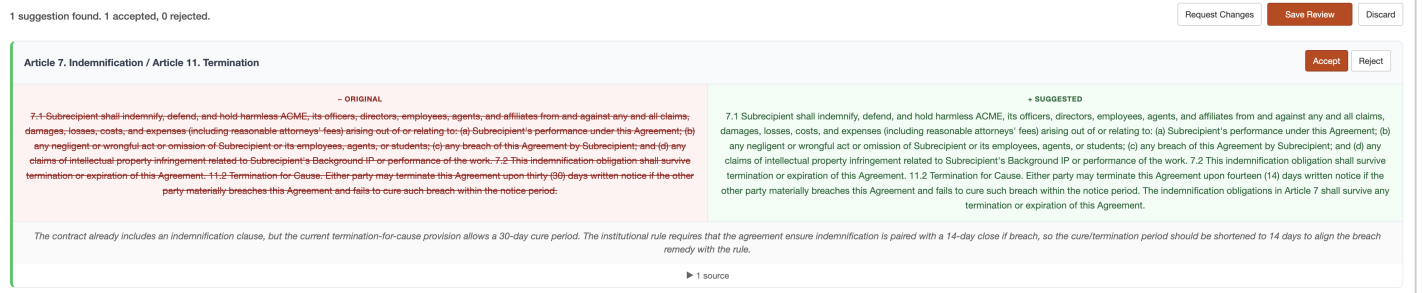
FundFit
Funding your researchers would never find on their own — matched to their actual work across federal, foundation, and corporate sponsors, with alerts and team-building built in.
Explore FundFit →HERD Visualizer
Know exactly where your institution stands. Every U.S. institution's research expenditures visualized — benchmark by funding source, discipline, and trend, on NSF HERD data.
Explore HERD Visualizer →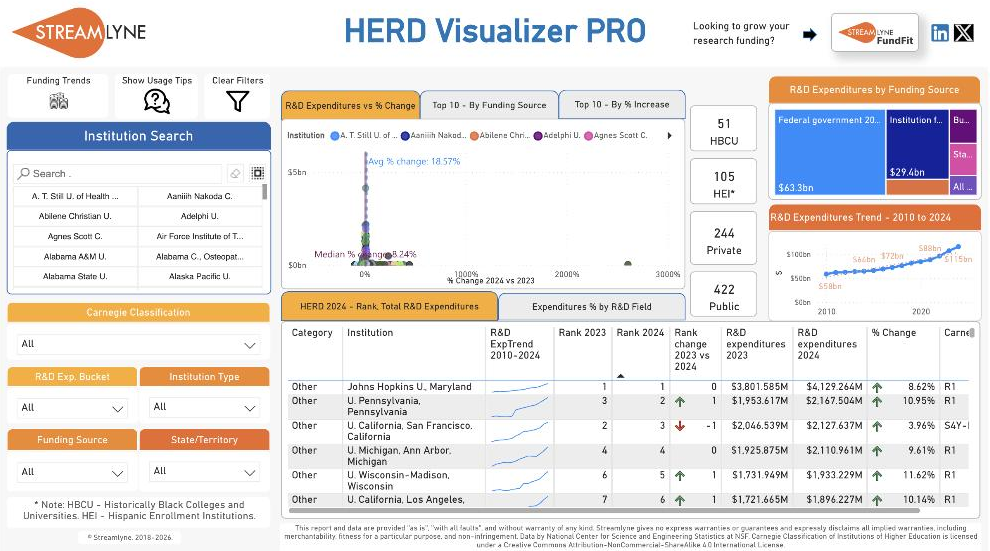
Open by design
Works with the AI your campus already uses
Your institution already has AI — Microsoft Copilot, ChatGPT, Claude, Gemini. Streamlyne connects to them, so your staff and faculty can ask about proposals, awards, and funding matches from the assistant they already know. No new tool to learn, no data locked away from the platforms your campus has already approved.
Built on the Model Context Protocol (MCP) — the open standard those platforms use to connect to enterprise systems. No other eRA suite offers it.
 Microsoft Copilot
 ChatGPT
 Claude
 Gemini+ any MCP-compatible agent
…and the enterprise systems you already run







20+ years in research administration · SOC 2 Type II certified · HECVAT · WCAG 2.2 AA · Zero data retention AI · AWS Partner
Customers
Research leaders on Streamlyne
I check it first thing in the morning, and within seconds, I see AI-matched opportunities that pair well with my research areas… FundFit is a huge time saver and gives me an edge in pursuing and winning funding.
 Jonathan LawsonSenior Director, Data Sciences PlatformBroad Institute of MIT & Harvard · FundFit
HERD Visualizer Pro has been a game changer for us… What once took days of manual data wrangling can now be done in minutes.
 Luis Cifuentes, PhDVice President for ResearchNew Mexico State University · HERD Visualizer
Lyn Pro was a huge help in double checking the compliance requirements for one of our proposals; it helped me catch the absence of an OLAW certificate!
 Andrew Stanger-LauterbachOffice of Contracts and Grants ManagementMedStar Health Research Institute · Lyn Pro
It feels like we finally have a smart, reliable partner that helps us connect the dots between our researchers’ work and matched funding opportunities.
 Alisha GironAVP, Research AdministrationNew Mexico State University · FundFit
In the 20 years I’ve worked with Research Admin Software vendors, Streamlyne’s responsiveness and collaboration are unmatched.
Rolling out FundFit felt like getting an operations upgrade for our whole research community.
 Jeri-Anne Lyons, PhDFmr. AVP for ResearchUniversity of Northern Colorado · FundFit
It is powerful and intuitive… I especially appreciate the ability to filter by top performers and benchmark against peers, which informs our annual strategic planning.
 Dr. Can SayginSenior Vice President for ResearchUT Rio Grande Valley · HERD Visualizer
FundFit is helping our Advisees to discover researchers outside of their usual networks… It is truly unique and impressive in its capabilities.
 Sue MerrileesSenior Director, Philanthropic AdvisingScience Philanthropy Alliance · FundFit
Our faculty, staff, and now students were up and running within days.
 Leighsa WashingtonExecutive Director, Sponsored Projects & RACalifornia University of Science and Medicine · FundFit
Written for research administrators
Before you book a demo
The questions procurement will ask
Do we have to migrate everything at once?
No. Streamlyne runs alongside your legacy system — module by module, on your timeline. You switch when you are ready, not when a contract says so.
How long until we see it working?
Value arrives module by module — your first modules go live and start working while the rest phase in. No waiting for a big-bang cutover at the end.
What happens to our historical data?
It comes with you. Awards, proposals, and protocols keep their history — nothing stays behind in the old system.
Who owns our data?
You do. Full export at any time, in standard formats. Your data is never held hostage to a renewal.
How does Lyn handle sensitive data?
Lyn works inside your permission model — it sees only what the signed-in user can see, and every action it takes is logged and reviewable. Zero data retention is enabled with our AI providers: your data is never stored by the model and never used for training.
How do you compare to Cayuse, Kuali, or InfoEd?
Feature for feature, side by side — see the comparison pages. Institutions consistently pay significantly less with Streamlyne. See the comparisons →