Streamlyne Research
The research administration system your office runs on
Proposals, awards, negotiations, and every compliance committee on one record — with Lyn drafting budgets, redlining agreements against your own policies, and answering questions inside the module you are already in.
What's in it
One system. Twelve modules.
Take the ones you need now. The rest are already in the same codebase, waiting for the year you are ready for them.
- Pre-awardProposal development
- Pre-awardSystem-to-system (S2S) submission
- AwardNegotiations
- AwardPost-award management
- Pre-awardInstitutional form builder
- ComplianceIRB
- ComplianceIACUC
- ComplianceCOI
- ComplianceIBC (biosafety)
- ComplianceExport control
- ReportingReporting
- IntegrationIntegrations
Lyn, built in
AI that does the part nobody wanted to do
Budgets, drafted
Lyn generates a budget from the justification and the sponsor's rules, so the first version of a complex budget takes minutes instead of an afternoon of spreadsheet archaeology.
Agreements, redlined against your own policies
Lyn reads an incoming agreement, marks the clauses that conflict with your institution's positions, proposes replacement language, and cites the policy it is reasoning from — so the reviewer checks a citation instead of taking a machine's word for it.
Questions, answered in place
Ask in plain language across proposals and records — which submissions are due next week, what changed on an award, where a protocol is sitting — and get the answer inside the module you are already in.
That is the whole list. Lyn does these three things well rather than claiming the rest of the lifecycle.
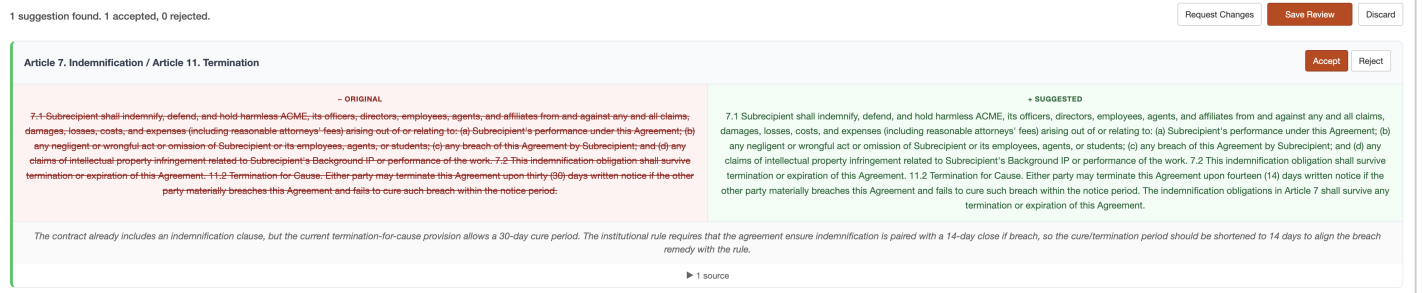
The citation is the point. A suggestion you cannot trace is a suggestion you have to redo by hand.
Pre-award
From intent to submitted
Proposal development with budgets, personnel, and sponsor forms on one record, and system-to-system submission to Grants.gov. Proposals that never went through the system still get a home: the Proposal Log captures paper submissions and awards that predate an electronic proposal, so the record of truth stays complete.
- Proposal development with sponsor-specific forms and budgets
- System-to-system (S2S) submission
- Proposal Log for paper and pre-electronic submissions
- Institutional form builder — your questions, your workflow, configured by your staff
Award
Negotiation through closeout, on one record
The award keeps the proposal's history rather than starting a new one. Negotiations, funding actions, report obligations, and outgoing subawards all hang off the same record, so nothing is re-entered and nothing quietly diverges.
- Negotiations, with export-control activity tracked alongside
- Award report tracking — every sponsor-required report, its due date and status, in three standard views that you can re-sort and group
- Subawards: pass-through and subrecipient contacts, funds released, anticipated funding
- FDP subaward agreements and modifications generated from the data you already hold
Compliance
Five committees, one workflow engine
IRB, IACUC, and IBC share the same submission, review, and committee machinery, so a coordinator who learns one learns all three. COI collects significant financial interests from anyone designing, conducting, or reporting research. Export control tracks export-controlled activity and works with Negotiations.
- IRB — human subjects protocols, amendments, continuing review
- IACUC — animal care and use protocols
- IBC — biosafety, sharing the same user and committee functions
- COI — financial disclosure for faculty, students, and staff
- Export control — activity tracking wired into Negotiations
- Protocols link to proposals, institutional proposals, and awards
Reporting
Reports your team builds, not tickets your team files
Streamlyne Reporting is a full business-intelligence tool inside the system, reading from a replicated database so heavy queries never slow down the people doing the work. Building a report is drag-and-drop — or SQL, if you would rather — and it does not require knowing the schema.
- Over 130 out-of-the-box reports across every module
- Drag-and-drop report building, or SQL for the people who want it
- Interactive dashboards with drill-down, assembled and shared by users
- Scheduled delivery by email
- Export to CSV, PDF, text, HTML, XML, and Excel
- Production database replicated in real time so reporting never competes with transactions
Integration
It has to talk to HR and Finance, or it isn't a system of record
We were a technology consultancy before we were a software company, and integrations are the part of this work we have done longest. Institutions run Streamlyne alongside Workday, Oracle Financials, Oracle e-Business, PeopleSoft HR, Banner HR, Banner Financials, One Solution, and homegrown systems.
- HR and single sign-on via ETL flat files on a nightly batch, or REST API in real time
- Inbound financial data feeding budget-to-actuals reporting
- Two outbound award integrations for your data warehouse or financial system
- Custom work when the standard set is not enough — the largest to date is 132 integrations at USC
Start where it hurts most.
Most institutions do not begin with all twelve. They begin with the module that is costing them the most time — pre-award for one office, IRB for another, reporting for a VP who cannot get a straight answer about the portfolio — and they run it beside the legacy system until it has clearly won. Then they take the next one.
There is no big-bang cutover in that plan, and no year of parallel data entry at the end of it either.
Questions
What procurement will ask
Do we have to take all twelve modules?
No. Start with the modules your office actually needs and add the rest when you are ready. The system is one codebase either way, so growing into a module later is a configuration exercise, not a second implementation.
Do we have to migrate everything at once?
No. Streamlyne runs alongside your legacy system — module by module, on your timeline. You switch when you are ready, not when a contract says so.
What happens to our historical data?
It comes with you. Awards, proposals, and protocols keep their history — nothing stays behind in the old system.
Can our own staff change forms and workflows?
Yes, and this is the difference that shows up in your budget rather than in a demo. The institutional form builder and the reporting tool are both designed for administrators, not developers. If every form change needs a statement of work, you are paying for that system twice.
How does Lyn handle sensitive data?
Lyn works inside your permission model — it sees only what the signed-in user can see, and every action it takes is logged and reviewable. Zero data retention is enabled with our AI providers: your data is never stored by the model and never used for training.
Who owns our data?
You do. Full export at any time, in standard formats. Your data is never held hostage to a renewal.